Case study / Conversational UI
Comic Buff
Teaching a hobby by talking, not by reading another long article.
Comic Buff is a conversational web app that helps beginner and intermediate collectors learn comic evaluation, grading and market trends. It is a text-based chatbot built in Voiceflow, where the lesson arrives as a conversation instead of a wall of text.
01 / The problem
The knowledge exists. It is just scattered.
Comic collecting is a rich hobby built on niche knowledge: grading systems, rarity, historical context. Almost all of it lives in forums and dense articles, which is fine if you already know the vocabulary and hopeless if you do not.
That gap is the barrier. Someone who loves reading comics and wants to start collecting has to first learn how to learn about collecting.
02 / The solution
Break the subject into things you can ask about.
Comic Buff turns collecting into digestible modules delivered through chat. You ask, it answers, and it suggests where to go next rather than waiting to be asked.
- Evaluation and gradingGuides through the grading standards and what actually moves a grade.
- GlossaryThe common terms, defined in passing rather than in an appendix.
- TrendsSpotting which comics are moving and why.
- Originality checksHow to judge whether what you are holding is what it claims to be.
- Knowledge journeysStep-by-step routes with proactive suggestions, so nobody stares at an empty prompt.
03 / How it was built
The content audit was the design work.
The bot was built in Voiceflow and trained on a curated content inventory: CGC standards, a glossary, collector blogs. That inventory was structured into intents, flows and utterances so the replies land in context rather than by keyword.
Getting that taxonomy right before building the flows is what made the conversation hold together. See the full content inventory.
04 / Who it is for
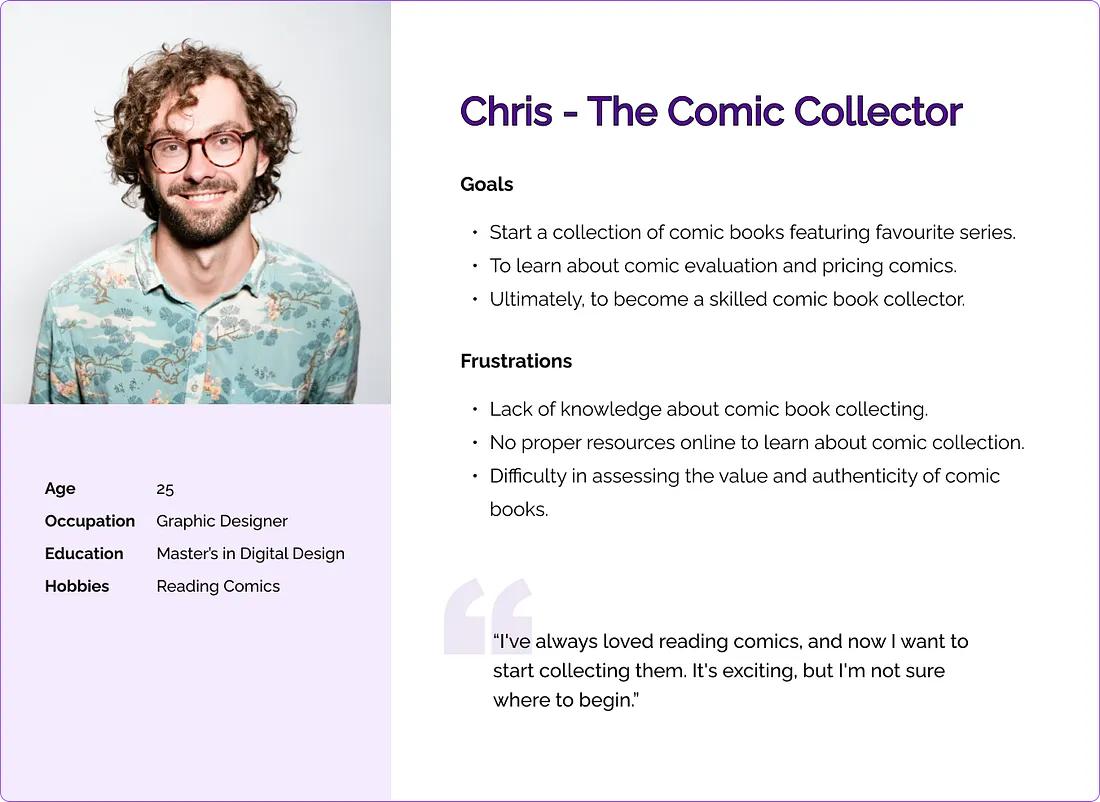
Chris, who reads comics and wants to collect them.
A twenty-five year old graphic designer who has always read comics and now wants a collection, with no idea where to begin. His frustrations were the brief: no knowledge of collecting, no decent resource online, no way to judge value or authenticity.
05 / The journey
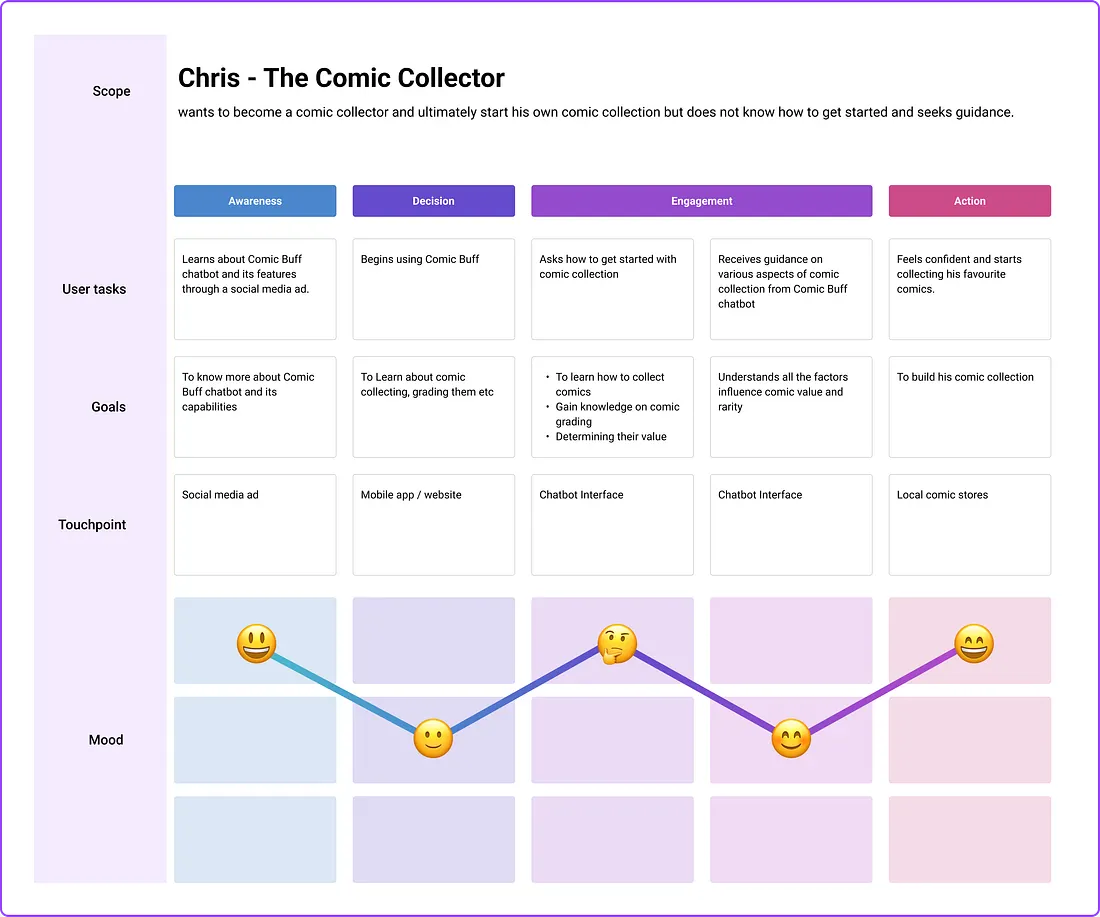
Four stages, and the dip in the middle.
Mapping Chris from the ad that introduces the bot through to walking into a comic store showed where confidence drops: the moment he asks how to actually start and gets a wall of factors back. That dip is what the proactive suggestions are for.
06 / What testing said
Three collectors, ten minutes each, four clear notes.
Usability testing ran on the Voiceflow prototype with three participants, averaging ten minute sessions. Small, but every session said the same four things.
- 01Show, do not only tellGrading is visual. Users wanted images alongside the explanation.
- 02Let me go backRetracing steps was hard, which pointed at a persistent "go back" trigger.
- 03Suggest the next stepPeople expected guided pathways rather than a bot waiting for input.
- 04Say lessSome replies ran long and attention dropped partway through.
07 / What shipped
A working bot and the structure under it.
The chatbot
Structured flows in Voiceflow with 25+ intents and dynamic topic branching.
Interface samples
Lightweight desktop and mobile UI, ready for a future web integration.
Content inventory
A domain-specific data set and taxonomy, which doubled as the training input.
Learning paths
Modular flows that adapt to the route taken, beginner or advanced.
08 / Why it matters
It meets people who would rather ask than read.
The conversational format lowers the cost of learning. Instead of committing to a long blog post, you ask one question and get one answer, then another. That suits casual hobbyists and younger collectors, the exact people the forums lose.
09 / Learnings
A conversation is only as good as the content behind it.
- A conversational UI is only as strong as its content structure. The upfront audit and taxonomy are what let the bot answer in context rather than by keyword.
- Even with sound logic, people want visual reinforcement. In a subject like grading, where the standard is visual, words alone will not carry it.
- Scaffolding matters. Proactive suggestions, summaries and a way out are what keep a conversation from stalling.
Thank you for reading! :)