Case study / Waste Management
Texitag
Making garment recycling personal, visual, and worth doing.
This project aimed to design an intuitive dashboard for Waste Management (WM) that bridges the gap between consumers, manufacturers, and recyclers, promoting sustainability in the fashion industry. The primary focus was creating a mobile-friendly garment tracing dashboard for consumers to understand their clothing usage, recycle efficiently, and contribute to a circular lifecycle.
01 / The problem
Clothes go in the bin because nobody shows them another way.
- Lack of consumer awareness about garment lifecycles and responsible disposal options.
- Inefficient textile recycling processes due to limited garment tracking and traceability.
- Need for a user-friendly platform to engage consumers in sustainable fashion practices.
02 / The goal
One interface for the whole life of a garment.
the goal
An intuitive dashboard enabling garment tracking, educating consumers on recycling, promoting a circular lifecycle, encouraging sustainability, reducing waste, and enhancing user engagement in a seamless interface.
03 / The insight
Most people want to recycle, but don't know how.
Most people say they care about sustainability, but their behavior doesn't reflect it. In fashion, that gap is massive. The average consumer doesn't know when or how to recycle clothes, and Waste Management was seeing growing textile waste despite rising awareness.
The problem wasn't just behavior. It was a lack of clarity, visibility, and motivation.
04 / The pivot
A dashboard wasn't the answer until I reimagined it for real life.
I was tasked with designing a garment lifecycle tracker for Waste Management. Originally scoped as a web-based dashboard, early feedback revealed a major flaw: most users don't engage with sustainability on desktop.
Web-based dashboard
lives in the browserMobile-first, scan-based
lives next to the closetSo I flipped the concept into a mobile-first, scan-based experience that lived closer to the closet, not the browser.
05 / The solution
When users scan a shirt, they see its full story.
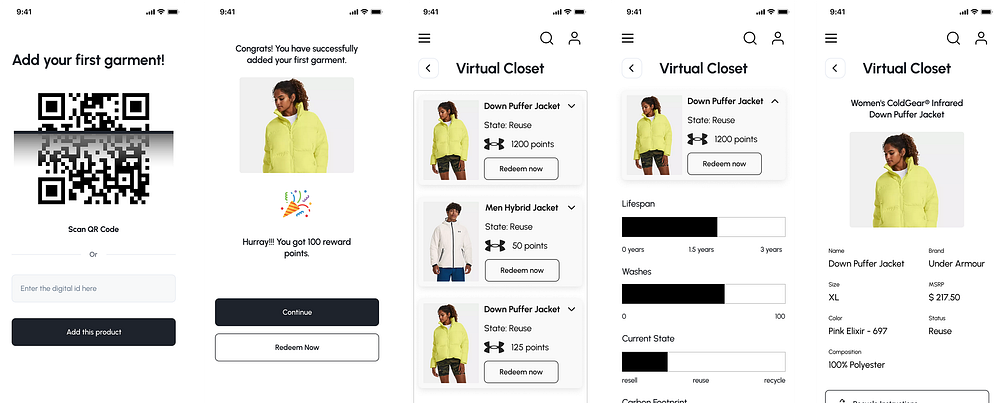
I designed Texitag to act as a companion for each piece of clothing, helping users track wear, lifespan, and impact. It was about building awareness through interaction.
Core features
Smart Closet
Scan garments and log usage, ownership, and material data.
Lifecycle Timeline
See how long an item has been worn, reused, or has sat idle.
Eco Credits
Earn rewards for reusing, donating, or recycling clothes.
Sustainability Nudges
Bite-sized facts and goals to keep users engaged.
06 / Collaboration and ecosystem integration
Designed alone, planned with partners.
While the design was executed independently, close coordination with sustainability consultants helped prioritize the metrics WM needed to track. We also scoped partnerships with in-store vendors and municipal recycling programs for QR integration and tag deployment.
Outreach strategy highlights
QR tags on garbage bins
In-store discounts for scan participation
Education layered across channels (dashboard, print, municipal content)
07 / Impact
Good for people, useful for the business.
How does this help users?
- Visualizes impact: Users feel more connected to their clothing habits
- Creates motivation: Small nudges + eco rewards = better daily decisions
- Reduces decision fatigue: Simple scan-to-recycle process
- Makes sustainability personal: Not just ethical, but gamified
How does this help the business?
- Improves recycling engagement: More clothing is tagged and processed
- Drives user retention: Rewards and streaks keep users active
- Supports partnerships: Enables brand and retailer integrations for impact tracking
- Informs data strategy: Aggregate wear/use/recycle data supports WM's reporting
08 / Takeaways
Behavior change is a systems problem.
Texitag showed how education, motivation, and design can intersect to create real environmental change. Designing for behavior change, especially around sustainability, requires more than just UI polish. It needs systems thinking, data visibility, and habit-forming design.
Thank you for reading! :)