EdAbroad is a platform designed to help Indian students confidently plan their study abroad journey, starting with the most underserved group: design and art students. It replaces biased consultancy advice with personalized program matching, mentorship, and application tracking. Built as my UX master's thesis, EdAbroad was validated through user research, lean experiments, market validation, and multiple rounds of testing.
01 / The problem
Good students, bad advice.
Indian students in creative fields (like design, fine arts, and architecture) often face misinformation, biased consultancy advice, and a lack of personalized guidance. My research showed:
85%of creative field students reported receiving misaligned or incomplete guidance.
Students rely heavily on consultancy agents who often prioritize commissions over student fit.
85% of creative field students reported receiving misaligned or incomplete guidance.
There's a lack of visibility into deadlines, program requirements, or community support.
Poor program fit leads to wasted money, delays, and even visa rejection.
02 / The challenge
One question to design around.
how might we
help Indian students misguided by traditional consultancies make better decisions about studying in the U.S.?
03 / The opportunity
A gap for something student-first.
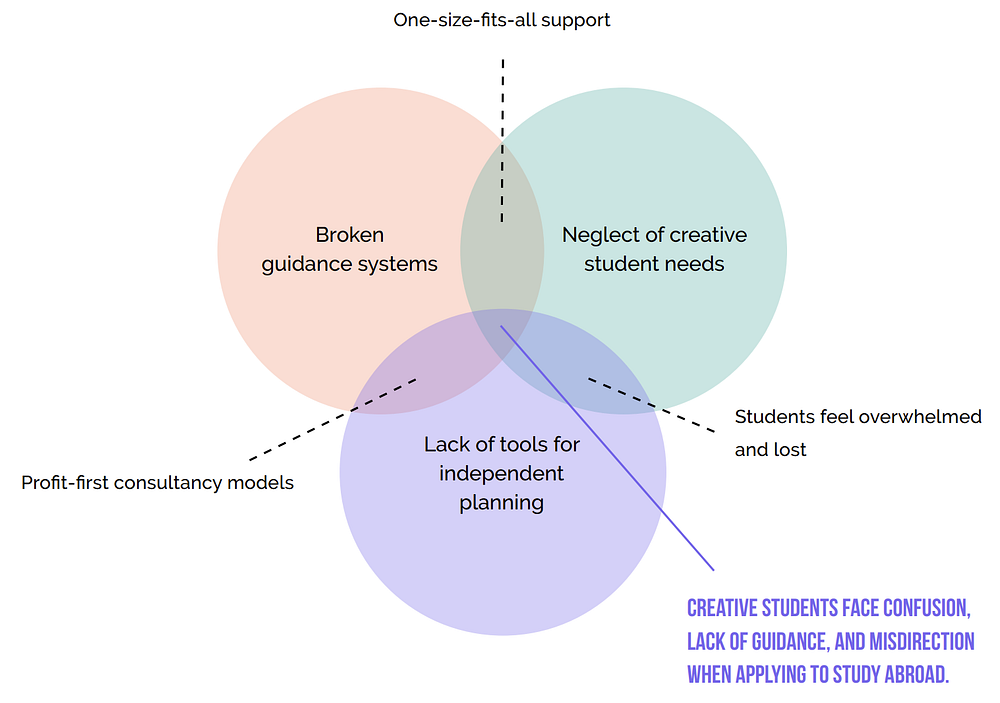
India's study abroad landscape is dominated by profit-driven consultancies and generic, one-size-fits-all advice. Students lack trusted tools for independent planning, leading to confusion, misdirection, and missed opportunities.
There's a clear gap for a transparent, student-first platform.
Three failures overlap on the same student: broken guidance, ignored creative needs and no tools to plan alone.
04 / The solution
Clarity and control, in one app.
EdAbroad is a personalized, AI-powered mobile platform that helps Indian students, starting with creative fields, plan their study abroad journey with clarity and control.
Matches students with best-fit U.S. programs using AI-powered recommendations.
Reduces stress with clear timelines, guided steps, and real-time application tracking.
Supports students from exploration to admission, saving them time, energy, and missteps.
Expected impact
75%less time spent shortlisting programs
50%better program and student alignment
50%fewer dropouts and last-minute deadline panics
student confidence and autonomy in decision-making
05 / Design outcomes
Three things the app does for you.
01
Smart shortlisting
AI recommends programs based on quiz data, like preferred programs, goals, academic background, and test scores like IELTS and GRE, and gives transparent match scores. This replaces guesswork and biased suggestions with clarity and relevance, addressing the core issue of program and university misalignment.
02
Mentor matching
Students are paired with alumni-based mentors who studied similar fields, solving the problem of isolation and generalized advice by providing real guidance from those who've been through the process.
03
Application support and tracker
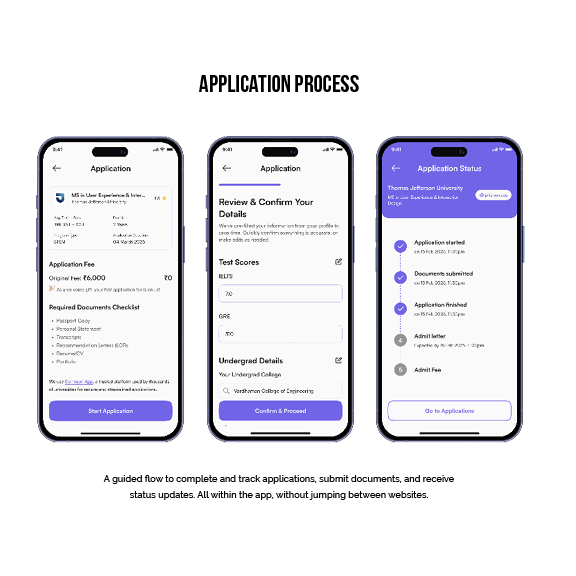
In-app application support, personalized task breakdowns, and reminders ensure students stay on track and meet deadlines without stress. This reduces deadline anxiety and prevents delays, a common failure point reported in user interviews.
A guided flow to complete and track applications, submit documents, and get status updates, without jumping between websites.
06 / Research, phase 1
Finding the root cause.
Interviewed 12 students across various academic backgrounds.
Identified 4 key pain points:
07/12
Students faced financial loss
“I ended up paying them ₹7000 and I got my certificates back, and I did not work with that consultancy anymore.”
11/12
Students received irrelevant guidance
“So they were trying to hook me up to this technical courses like information systems or computer science, which I had zero interest pursuing.”
09/12
Students faced stress, regret, and mental health strain
“They demotivated me… they were like, you won't be getting into this college… I had to raise my voice for them to apply it.”
07 / Research, phase 2
Market validation through pretotyping.
Fake front door test7 days
31.1%conversion, 14 of 45 signed up
I launched a simple one-page landing site to explain EdAbroad's benefits and measure interest. In 7 days, the page had 45 unique visitors and 14 signups, giving a 31.1% conversion rate. Since this was above the 25% success threshold, the experiment is considered a success.
Mechanical Turk test30 days
3/3trusted the AI matches
To simulate AI recommendations, I manually curated university matches for 3 students based on their profile inputs and presented them as AI-generated, with a short explanation for each: “Why is this a good match for you?” Surprisingly, 2 out of 3 students had already shortlisted some of the programs I suggested, reinforcing the match accuracy. After 30 days, I followed up to check if they had considered or shortlisted any of those programs. All 3 confirmed they had and expressed greater trust in AI-based suggestions over consultancies' generic advice.
Pinocchio testform vs. app
1/4completed the form flow
I created a long Google Form that mimicked the full application process, asking for profile details, academic history, interests, and preferences in separate forms linked internally. Half of the participants dropped off midway, saying it felt like “just another boring form.” But after I showed them the EdAbroad app flow (same steps, but designed interactively), they were impressed and felt more motivated to complete it.
08 / Research, phase 3
Five students, seven tasks each.
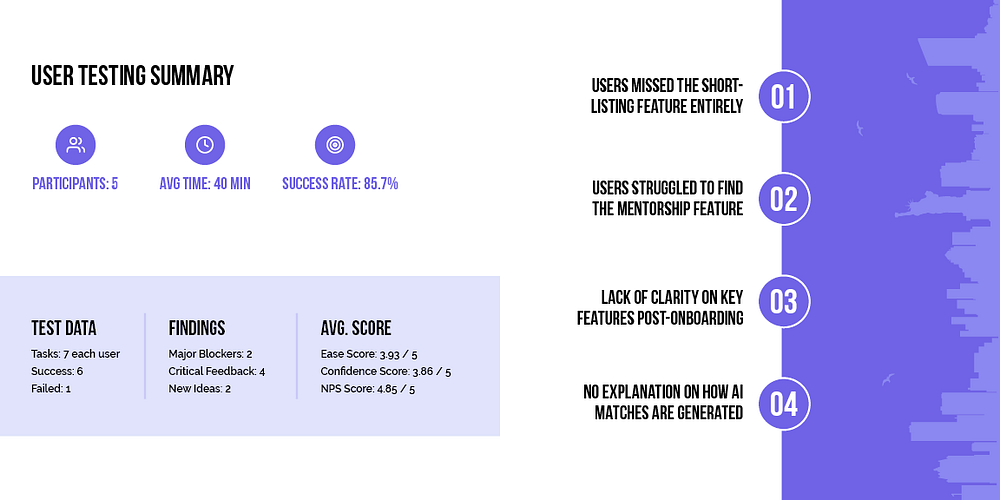
I tested the EdAbroad prototype with 5 students. Each completed 7 tasks designed to simulate real usage.
Finding 1
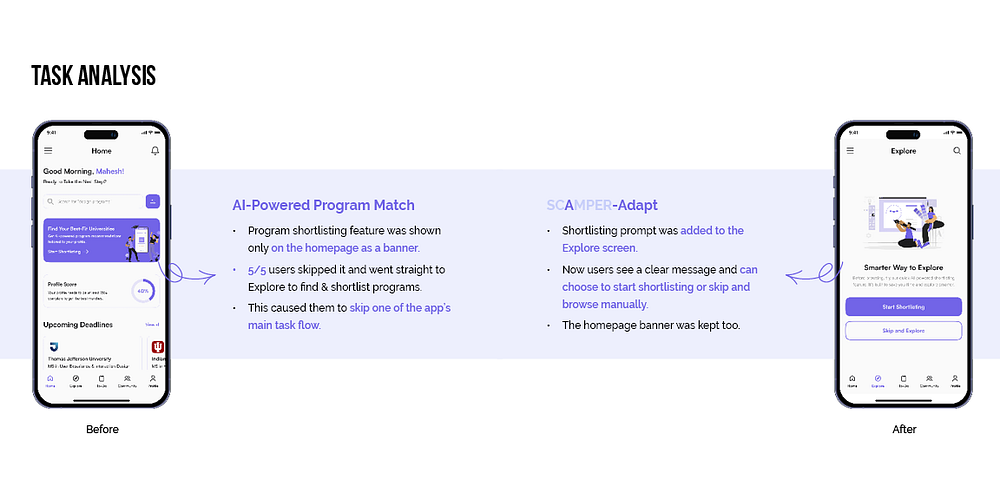
5/5 users missed the AI-powered program matching feature.
Finding 2
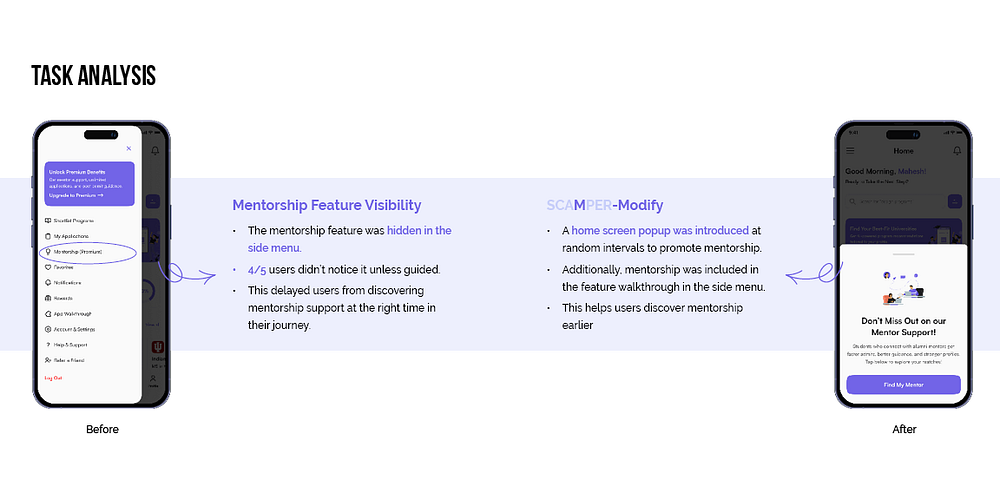
4/5 users didn't notice the mentorship feature unless guided, because it was hidden in the side menu.
What changed
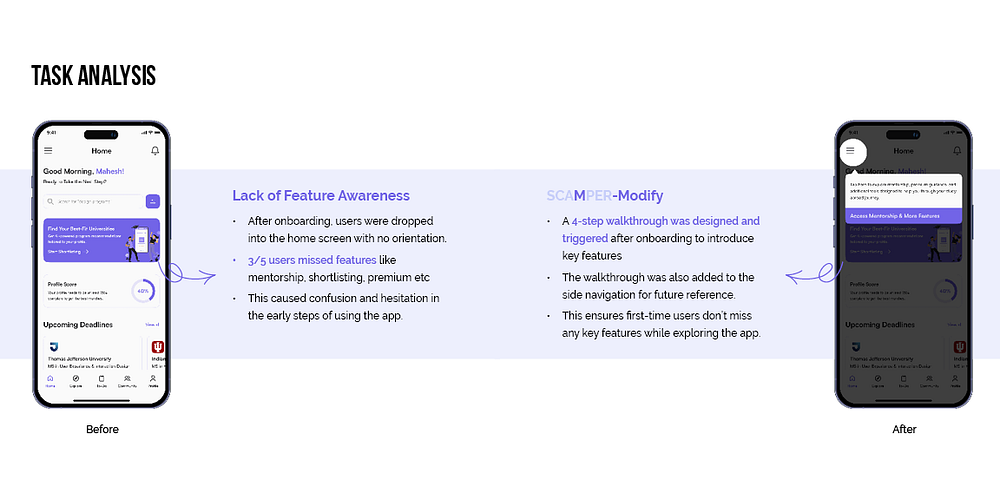
AI-powered program match: the prompt moved to where students actually go looking.Mentorship: out of the side menu and in front of students at the right moment.Feature awareness: a four-step walkthrough right after onboarding, and again from the side menu.
09 / Business and strategic vision
More than an app.
EdAbroad is more than an app: it's a scalable ecosystem. Starting with creative students and the USA was intentional, but it supports other fields (CS, medicine, business) and global expansion (Canada, UK). Designed to align with ethical partners and scalable through community trust.
Revenue model
FreemiumCore features free for all
Premium tier₹15,000 one-time upgrade for mentorship and full application support
University partnershipsEthically aligned referrals
Application processingService fee per successful submission
White-label licensingFor undergrad schools and consultancies
EdAbroad 2.0
loading…
AI-powered chatbot
Pre-existing shortlist analyzer
Expand to other fields and countries
10 / Key learnings
What I would keep doing.
Start with a sharp niche
Creative students faced the most pain, which gave the product immediate relevance.
Validate early
Pretotyping helped avoid wasted design cycles.
Trust is the real UX
AI only worked because the match reasoning was explained clearly.
Good design reduces emotional load
Confidence and structure were just as important as clean UI.
Scaling ethically is a strategy
Avoided affiliate revenue to maintain user-first integrity.